

The Grey Foam-Nest Tree Frog | A Safari Encounter in the Greater Kruger
Updated: 7 days ago
A TINY SURVIVOR WITH BIG ADAPTATIONS
In South Africa's semi-arid climate, where water is often scarce, the grey foam-nest tree frog (also called the southern foam-nest tree frog) has developed fascinating strategies to conserve every drop. Its most impressive trick is uricotelism, a unique process that allows it to excrete waste in solid form, minimizing water loss. Watching this resilient creature, I marveled at how it’s perfectly designed for survival in such challenging environments.
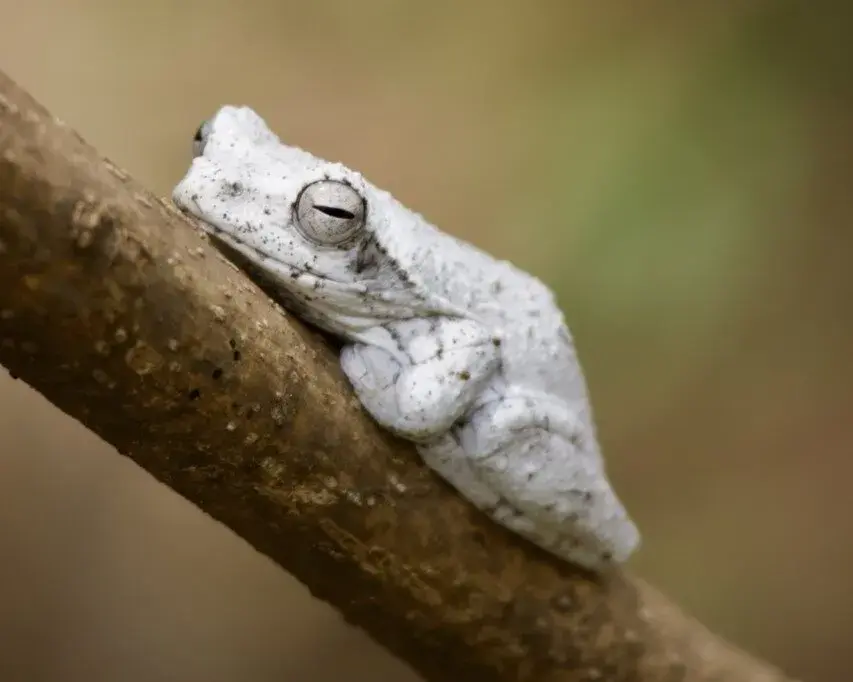
During my encounter, I noticed its color-shifting ability. As the day warmed, the frog transitioned from a dark brown shade, blending perfectly with tree bark, to a chalky white hue, reflecting the sun’s rays to stay cool. This colour change serves both as a thermoregulatory shield and a brilliant camouflage against predators.
WATER CONSERVATION: A MASTERCLASS IN RESOURCEFULNESS
Imagine a world where every drop counts. The grey foam-nest tree frog has perfected this mantra through a fascinating biological trick: uricotelism. By excreting uric acid instead of urea, the frog eliminates waste in solid form, conserving precious water. Up to 75% of its nitrogenous waste is converted this way, a strategy that allows it to endure long stretches without access to water.
SHAPESHIFTING FOR SURVIVAL
Like a character out of a fable, the grey foam-nest tree frog can change its colour to adapt to its environment. In the cooler, shaded hours, it dons a dark brown coat, absorbing warmth and blending with tree bark. As the day heats up, its skin turns white, reflecting sunlight and keeping its tiny body cool. This dual function of thermoregulation and camouflage is nothing short of ingenious.
Types of Pigment Cells (Chromatophores)
Amphibian skin contains specialized pigment cells called chromatophores, located in different layers of the skin. These cells produce and manipulate colour:
• Melanophores: Contain melanin, producing black, brown, or gray pigments.
• Iridophores: Reflect light using guanine crystals, creating iridescent or metallic effects. These contribute to blues and greens.
• Xanthophores: Contain yellow or red pigments (carotenoids and pteridines).
Pigmentation Disorders
Pigmentation anomalies may occur due to genetic mutations, environmental stressors, or diseases. Examples include:
• Albinism: Lack of melanin, leading to white or pale skin and red eyes.
• Leucism: Reduced pigmentation in all chromatophores, resulting in pale coloration but not affecting eye colour.
• Melanism: Excessive dark pigmentation

Grey foam-nest tree frog with mottled brown skin, camouflaging against the tree bark
A WORLD THROUGH AMPHIBIAN EYES
Step into the world as the frog sees it a realm of near 360-degree vision, acute motion detection, and even the ability to perceive ultraviolet light. Large, prominent eyes allow this frog to track prey with precision and evade predators with agility. Whether in dim twilight or the glaring midday sun, its vision is a lifeline.
The pupil shape of Anura can be horizontal or vertical. Horizontal pupils are common in diurnal frogs for wide field views. Vertical is applicable for nocturnal species with low-light sensitivity sight.
THE FOAM-NESTING PHENOMENON
One of the most intriguing aspects of this species is its foam nest, typically found in trees overhanging water sources. The female creates this protective foam to house and nourish her eggs, ensuring the tadpoles have a safe journey into the world.
A WELL-DESERVED SPOTLIGHT
Beyond its unique adaptations, this frog plays a crucial role in the Greater Kruger ecosystem. Acting as both predator and prey, it helps maintain the delicate balance of the food chain. Its presence is also a sign of a healthy environment, a key indicator for conservationists like those of us at Tsala Trails who are deeply committed to preserving South Africa’s wild spaces.
TIPS FOR SPOTTING AMPHIBIANS ON SAFARI
If you're an amphibian enthusiast or simply curious about the smaller wonders of the bushveld, here are a few tips for spotting creatures like the grey foam-nest tree frog:
• Look up: these frogs often perch in trees, particularly near waterholes.
• Go nocturnal: many amphibians are more active after sunset, and guided night walks are perfect for sightings.
• Listen closely: their unique calls often give away their location before you spot them.
SAFARI MOMENTS TO TREASURE
South Africa's Greater Kruger National Park is renowned for its Big Five sightings, but encounters with smaller wildlife, like the grey foam-nest tree frog, are just as enriching. These moments remind us of the interconnectedness of life in the wild, from the tiniest frogs to the mightiest elephants.
At Tsala Trails, we aim to share these stories with our guests, helping you connect with the beauty of nature in all its forms. Whether it’s the call of a frog or the rustle of leaves in the breeze, every sound and sight carries the spirit of Africa’s wilderness.

Grey foam-nest tree frog on a branch
Photos taken on a Tsala Trails Walking Safari on Balule Game Reserve, 19 to 22 November 2024. Browse our Greater Kruger Trails here.
Explore our Premium Safaris for a deeper experience of Africa
or design a Tailor-Made Journey shaped around your curiosity and comfort.
Interested in frogs and other amphibians? In foam nests hanging over the water?
Ask us and join one of our summer walks in Greater Kruger.


Comments