

The Places We Choose | And Why That Matters on a Walking Safari in South Africa
Updated: Sep 10

NOT ALL SAFARI DESTINATIONS ARE CREATED EQUAL
Not all safari destinations are created equal, and that becomes clearer the longer you spend out there. After more than a decade guiding across Southern Africa, I’ve come to understand something that feels simple but takes time to truly see. The quality of a safari is not defined by how much you see. It is defined by where you are when you see it, and whether that place allows the moment to unfold naturally.
At Tsala Trails, the places we choose are never accidental. They shape everything. They determine not only what you encounter, but how you experience it, and ultimately what stays with you long after you’ve left.

SOME PLACES LET YOU SLOW DOWN - OTHERS DON"T
I’ve worked in areas where the radio never really stops, where sightings build quickly and vehicles arrive from all directions, where there is a quiet but constant pressure to move on, to make space, to keep up, to deliver the next moment before the current one has had time to settle. In those environments, the bush begins to feel managed, even when it is wild.
And then there are places where none of that exists. Places where you can pick up a track and follow it without interruption. Where a sighting is not something you arrive at, but something you slowly become part of. Where time stretches rather than compresses, and nothing is rushed because nothing needs to be. Those are the places that stay with you.
WALKING CHANGES WHAT MATTERS
Walking changes what matters. The moment you step off the vehicle and onto the ground, your priorities shift. It is no longer about proximity in the conventional sense, or about counting sightings. It becomes about awareness. About understanding wind direction, reading subtle movement, recognising when to pause instead of pushing forward. It is about being present enough to notice the detail that would otherwise pass unseen.
In the wrong environment, that becomes difficult. Too many vehicles, too much pressure, and too much interference begin to close the space that walking depends on. But in the right place, everything opens up. Animals behave differently. The smaller things start to carry weight. The experience becomes immersive in a way that cannot be replicated from a vehicle, because you are no longer observing from the outside. You are participating, carefully and respectfully, within the system itself.
NOT EVERY LANDSCAPE IS MEANT FOR WALKING
Not every landscape is suited to this way of experiencing the wild. You start to notice it in the terrain, in how the land moves and holds life, in how water draws animals in and how long a track remains readable before it disappears. In parts of the Waterberg, there is a rhythm to the mountains and a quietness between them that allows you to slow down almost without realising it. Along the Olifants River, there is constant movement, a sense of life flowing through the landscape, animals coming and going, birds calling, everything shifting in subtle ways. In places like Hwange, the open woodland and waterholes create moments that unfold slowly, often without the need to move at all.
These are the environments that allow walking to be what it should be. Unhurried, observant, grounded.
THE LODGE SHOULD NEVER BE THE MAIN EVENT
That same thinking extends to where you stay. The lodge should never be the main event. It should support the experience rather than compete with it. We have chosen not to anchor ourselves to a single property because that freedom allows us to work in places that genuinely suit the experience, rather than trying to force an experience into a place that does not naturally allow it. The best lodges offer comfort, but they do not distract from why you are there. They keep you connected to the environment rather than separating you from it.
THE SHIFT THAT HAPPENS WHEN YOU SLOW DOWN
After a day or two, something begins to shift. It is subtle at first. Guests start to move a little slower. Conversations soften. The need to see everything begins to fall away, replaced by a willingness to simply be present. That is usually when the experience deepens, not because something dramatic has happened, but because there is finally space for it to.
WHY THIS MATTERS MORE NOW
This matters more now than it ever has. Travel has become faster, more curated, and often more crowded. Truly quiet, low-impact wilderness experiences are becoming harder to find. Choosing the right place is no longer just about wildlife. It is about protecting the feeling of being there in the first place.
Because what makes these places so powerful is not always obvious at first glance. Much of what defines them lies beneath the surface, in systems that are rarely seen but always present.
BENEATH THE SURFACE, THE HIDDEN SYSTEM OF THE WILD
Long before mammals or birds, before even the first true forests, life was largely confined to water. Over a billion years ago, a lineage split from what would eventually become animals, and that lineage became the fungi. Modern science now shows that fungi are more closely related to animals than to plants, despite how often they are grouped with them.
At first, these organisms were simple and aquatic. Some of their descendants still are, producing motile spores that move through water, a reminder of their origins. But over time, as conditions on Earth changed, certain fungal lineages adapted to life on land. They developed filamentous structures known as hyphae, allowing them to penetrate surfaces and absorb nutrients directly. This was a fundamental shift. Unlike animals, which ingest food, or plants, which produce it, fungi digest externally and absorb what they need.
THE PARTNERSHIP THAT BUILT THE WORLD WE WALK IN
Around 450 million years ago, one of the most important partnerships in Earth’s history began to form. The first plants attempting to colonise land lacked true roots and struggled to access nutrients locked in rock and poor soils. At the same time, certain fungi had already evolved the ability to interact closely with plant cells. These fungi entered plant roots and formed structures where nutrients and carbon could be exchanged. Today, we know these as mycorrhizal relationships.
In those early systems, neither could survive without the other. Together, they transformed the land. They built the foundation for terrestrial ecosystems.
FUNGI AS THE ENGINE OF SYSTEMS
As life on land became more complex, fungal diversity expanded. Some groups evolved to dominate microbial processes, living quietly within plants, decomposing organic material, or acting as pathogens that regulate populations. Others developed the ability to break down lignin, the substance that gives wood its rigidity. This changed everything. Before this, forests accumulated without fully decomposing. Once fungi evolved the ability to break lignin down, nutrient cycling accelerated, soils developed, and ecosystems stabilised.
Today, these processes continue beneath your feet. What appear to be individual trees are often connected through vast underground networks formed by fungi. These networks move nutrients, redistribute water, and even allow chemical communication between plants. In many ways, the bush is not a collection of separate organisms, but a connected system.
WHAT YOU START TO NOTICE ON FOOT
Fungi sit at the centre of this system. They take on different roles depending on their function. Some act as decomposers, breaking down dead matter and returning nutrients to the soil. Others form partnerships with plants, exchanging minerals and water for sugars. Some act as parasites, regulating populations and shaping ecological balance. Others live quietly within plants, influencing health in ways we are still beginning to understand.
On a walking safari, these systems become visible in small, often overlooked ways. A fallen marula slowly returning to soil. A termite mound rich with fungal activity. The flush of mushrooms after rain. These are not isolated events. They are expressions of the processes that keep the ecosystem alive.
UNDERSTANDING THE FUNGI YOU ENCOUNTER
Among the fungi you may encounter are groups like Agaricus, a genus that includes some of the most familiar mushrooms in the world. These species are typically found on the ground, feeding on organic matter, playing their role as decomposers. They follow a predictable pattern, their gills changing colour as they mature, their presence tied closely to nutrient cycles in soil systems. Yet even here, caution is needed, as similar-looking species can be dangerously toxic. Understanding comes from careful observation, not assumption.
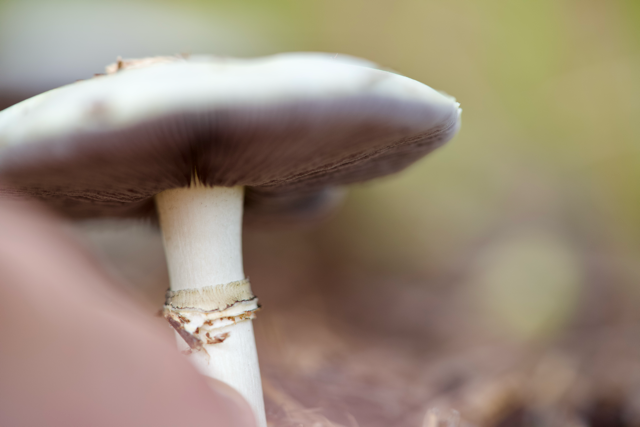
Then there are the smaller, more delicate fungi such as those in the genus Mycena. These are easily overlooked. They are small, fragile, often growing quietly on decaying material. But their role is no less important. They operate at a fine scale, breaking down leaf litter and organic debris, contributing to the early stages of decomposition that feed the entire system. In environments like the Lowveld or the Waterberg, they appear after rain, subtle but essential, part of the constant renewal of the forest floor.

Explore our Premium Safaris for a deeper experience of Africa
Or design a Tailor Made Journey shaped around your curiosity and comfort
Looking for an easier start
Ask us about shorter guided walks or private guiding for families and first timers


Comments